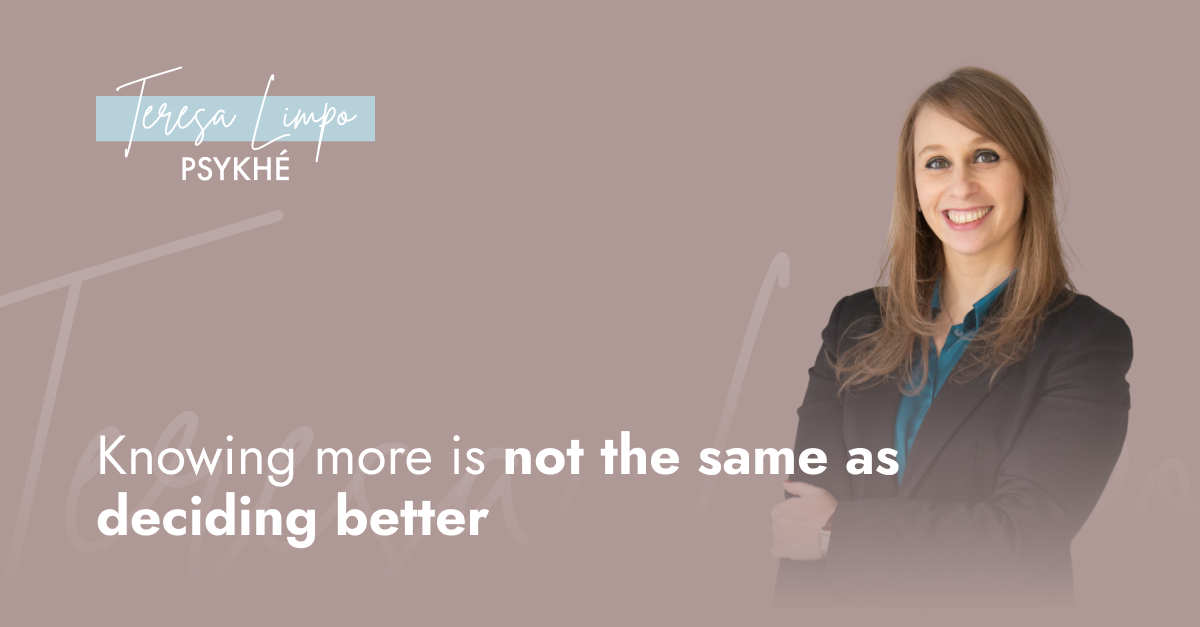



Have you ever felt that, the more professional training you add to your CV, the more insecure you seem to feel before a patient or an object of study? Whether in the clinic or the laboratory, the current focus is on “knowing, knowing, knowing.” Psychologists are bombarded with the latest trendy therapeutic model, the newest neuroscience discovery, or that must-attend weekend workshop.
However, keeping up with everything and accumulating knowledge is not the same as processing and applying wisdom. And even less so doing it with confidence, security, and ethics.
Many professionals boast of being in permanent “continuing education”, when in reality, this is often a defense mechanism. It is the illusion of competence: we believe that if we take one more course, read those 50 new articles, and have a library full of books, our anxiety will disappear and we will feel more secure in conducting our work. Unfortunately, the result is exactly the opposite.
- The excess of noise: When you have 10 different tools for the same problem, but do not understand the structure of the human behavior behind it, you will not have the confidence to choose one and apply it. You will become paralyzed.
- The wheat and the chaff: Without a solid foundation of reflection and critical thinking, it is impossible to distinguish robust science from what is merely therapeutic marketing, leaving you in a permanent state of indecision about what is central and what is secondary. While you work, the voice of insecurity will not leave you.
Whether in clinical practice or research, this translates into that feeling of being “lost in translation” between book theory and the real person sitting in front of us. The data is there, but it lacks meaning.
Imagine the psychologist who masters every diagnostic criterion for Borderline Personality Disorder, but, in the silence of the consulting room, feels paralyzed and cannot manage the negative transference of a patient who feels like a failure and subtly attacks them. The theoretical knowledge is there, but clinical decision-making competence—the “know-how” of being and intervening in the moment—is not found in books.
Or think of the researcher who masters their work’s topic exquisitely but sees their article blocked because they cannot decode, understand, or provide a strategic response to reviewers’ criticisms. Here, the problem is not a lack of data; it is a lack of clarity to navigate the review process and scientific politics.
What is missing is not another postgraduate degree or a book. What is missing is confidence, courage, and discernment. Deciding on a therapeutic path or the direction of an article requires the ability to filter the secondary to focus on the essential. It requires the “unlocking” of processes that theory, on its own, does not teach. Knowing is a process of absorption; deciding is a process of action.
And the transition between the two is where most professionals feel isolated. This is where seeking support gains its true value. It is not about having more information, but about having someone willing to listen to your fears and insecurities in a safe space to begin:
- Processing what you already know (transforming information into real competence).
- Knowing what to ignore (filtering the noise to focus on efficacy).
- Gaining security in decision-making (whether in a complex diagnosis or a rigorous experimental design).
Asking for help to organize mental chaos is not a sign of lack of knowledge—it is the ultimate sign of professional maturity. It is moving from passive accumulation to active mastery.